

The latest empirical data and authoritative third-party reports consistently confirm that, in mainstream outdoor operating conditions, DMEGC Solar's N-type photovoltaic modules deliver significantly superior overall power generation performance compared to BC modules. These findings are supported not only by comprehensive annual generation statistics but also by in-depth technical analysis and long-term reliability assessments that reveal the fundamental drivers behind N-type's performance edge.
A key case in point is the TÜV Rheinland empirical test data, which fully records 10 months of power generation from July 2025 to April 2026. In this real-world ground installation, the N-type modules outperformed BC modules in per-kilowatt electricity generation in nearly every single month, achieving a cumulative generation gain of approximately 1.01%. Notably, this advantage was more pronounced during winter and spring months (such as January and April 2026), demonstrating N-type's strong seasonal adaptability across varying climatic conditions.
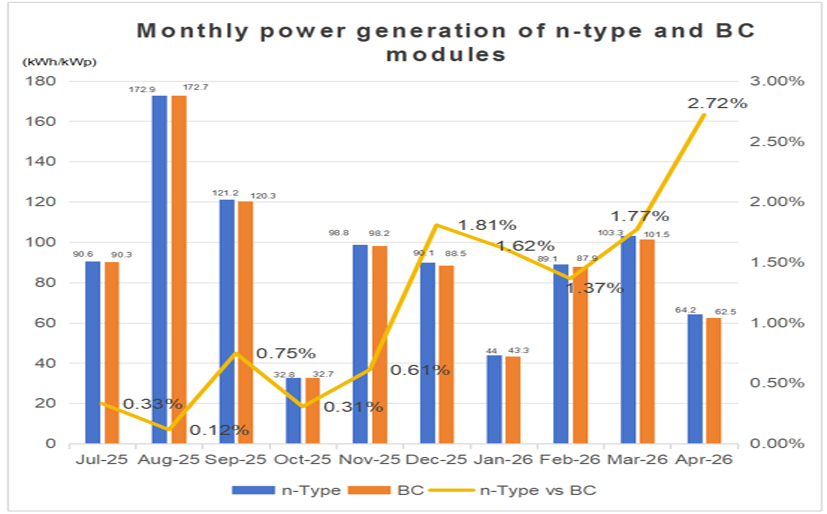
Industry researchers and analysts generally attribute N-type's outperformance to four critical technical advantages:
1. Superior Low-Irradiance Performance
Real-world operating environments are not always bathed in bright sunlight. Empirical evidence indicates that under low-light conditions—such as early morning, late afternoon, overcast skies, or cloudy weather (typically with irradiance below 400W/m²)—N-type modules exhibit a sharply amplified generation advantage.
2. High Bifaciality for Extra Yield
For ground-mounted systems or elevated distributed projects, rear-side generation is a substantial contributor to total output. N-type modules typically feature bifaciality ratios of 80%–85%, significantly outperforming BC modules, which generally range between 60%–70%. This means that N-type modules can effectively capture more reflected light, translating directly into higher overall energy harvest.
In summary, the comparative generation performance between N-type and BC modules is no longer a matter of theoretical debate—it is increasingly validated by hard empirical data. DMEGC Solar's N-type modules, with their excellent low-light responsiveness and outstanding bifaciality, collectively establish a robust foundation for achieving higher and more stable power output in complex, variable outdoor environments. These advantages translate directly into greater plant revenues and lower levelized cost of energy (LCOE), positioning DMEGC Solar's N-type technology as the more reliable and bankable choice for contemporary PV project investments.

Tel: +86-579-86588826 (Workday 8:30-17:00)
Tel: +31 (0) 8 58200765
Tel: +86-579-86310330 (Workday 8:30-17:00)
+86-579-86310330 (workday 8:30-17:00 GMT+08:00)
+86-579-86588601 (workday 8:30-17:00 GMT+08:00)


Contact Us
Type of your question
- Business Consulting
- Technical Support
- After-sales Service