

Commercial property managers and business owners frequently face the challenge of optimizing limited land resources. Two primary solutions often emerge for vehicle storage and energy generation: traditional enclosed garages and open-air solar structures. While standard garages offer protection from the elements, they represent a significant capital expenditure with no direct return on investment regarding energy production. In contrast, integrating photovoltaic technology into parking infrastructure transforms a passive asset into an active revenue generator. This shift is redefining how modern enterprises approach sustainability and operational efficiency.
Maximizing Land Use and Energy Generation
The most distinct advantage of solar-integrated parking structures is dual functionality. A standard garage consumes space solely for storage, requiring ongoing maintenance for roofing, lighting, and ventilation without generating income. Conversely, a canopy system utilizes the same footprint to produce clean electricity. This generated power can offset high commercial electricity rates, significantly reducing operational costs. For businesses with large fleets or extensive employee parking, the scale of energy production can be substantial.
Modern modules, particularly those utilizing N-type cell technology, offer higher efficiency rates and better performance in low-light conditions compared to older polycrystalline or standard P-type models. This technological advancement ensures that even in regions with variable weather patterns, the energy yield remains consistent and reliable. Companies like DMEGC Solar have pioneered these high-efficiency modules, enabling businesses to maximize output per square meter. By choosing advanced photovoltaic solutions, organizations can achieve faster payback periods and long-term financial stability through reduced utility dependence.
Structural Flexibility and Installation Efficiency
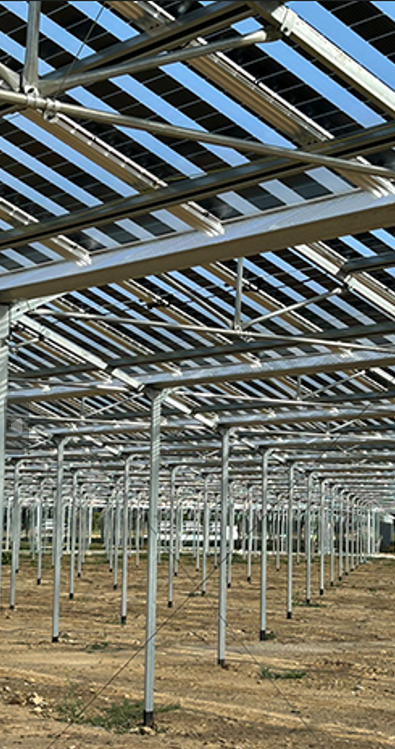
From a construction perspective, standard garages require heavy foundations, extensive framing, and complex permitting processes related to enclosed buildings. Solar canopies, while still requiring robust engineering, often involve simpler installation protocols. They do not need walls or complex HVAC systems, which lowers initial construction costs. Furthermore, these structures are highly adaptable. They can be designed to accommodate various vehicle sizes, from compact cars to heavy-duty trucks, making them ideal for diverse commercial applications.
For agricultural businesses or companies with vast open lots, the integration of photovoltaics into parking areas is just one aspect of broader land optimization. Similar principles apply to agrivoltaics, where land serves both agricultural and energy purposes. The versatility of modern mounting systems allows for the creation of efficient solar carports that blend seamlessly into existing landscapes. This flexibility ensures that businesses can expand their energy infrastructure without disrupting daily operations or requiring massive land clearing.
Conclusion
When evaluating long-term value, solar-integrated parking structures outperform standard garages for most commercial entities. They provide essential vehicle protection while actively contributing to corporate sustainability goals and financial savings. By leveraging high-efficiency N-type technology and strategic design, businesses can transform unused parking space into a critical component of their energy strategy. This approach not only reduces carbon footprints but also enhances brand reputation as a forward-thinking, environmentally responsible organization.

Tel: +86-579-86588826 (Workday 8:30-17:00)
Tel: +31 (0) 8 58200765
Tel: +86-579-86310330 (Workday 8:30-17:00)
+86-579-86310330 (workday 8:30-17:00 GMT+08:00)
+86-579-86588601 (workday 8:30-17:00 GMT+08:00)


Contact Us
Type of your question
- Business Consulting
- Technical Support
- After-sales Service